
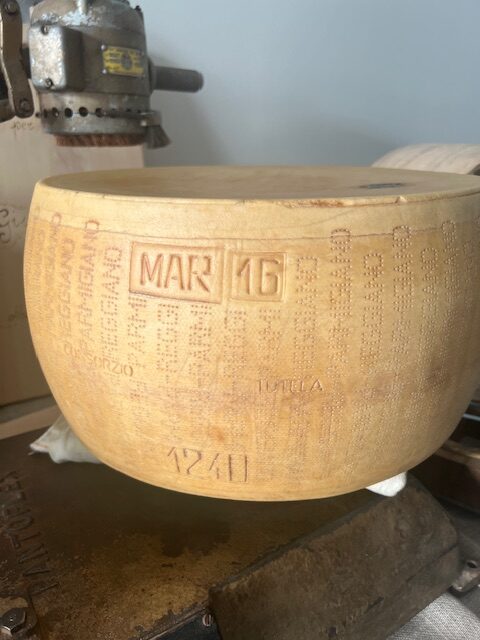
Fascinating facts about Parmesan Reggiano:
- The Modonne Caseificcio dell’ Emilia Parmesan factory produces 140 wheels of Parmesan (average weight of each wheel is 80 pounds). (Photo of Parmesan cheese wheels in the factory storage bunker below.)

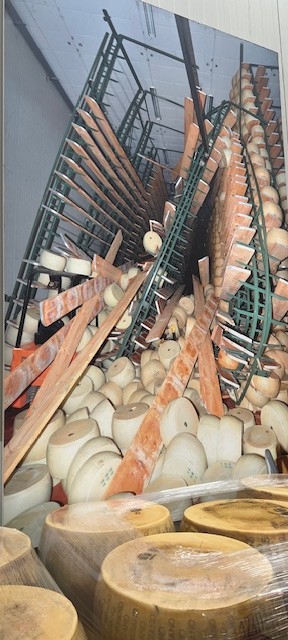
2. In 2012 there was an earthquake in Modena, where the factory is located which made almost all the 33,000 Parmesan wheels in their storage bunker to fall to the ground (photo below)
3.True Parmesan cheese is produced in the regions of Emilia-Romagna, Lombardy, and Veneto in Italy, following strict regulations to ensure its quality and authenticity.
4.The aging process of Parmesan cheese is crucial to develop its distinct flavor and texture. To be considered authentic, it must be aged for a minimum of 12 months, but some varieties can be aged for up to 36 months.
5.Parmesan cheese is practically lactose-free. During the aging process, the lactose in the milk is converted into lactic acid, making it safe for individuals with lactose intolerance to consume. It takes approximately 500 liters (132 gallons) of cow’s milk to create a single wheel of parmesan.
While visiting the Prosecco region of Italy, we drove to a Parmesan factory about an hour away in Modena. Upon entering the Madonne Caseificcio dell’Emilia there was no question that Parmesan cheese was being produced there. The most marvelous aroma of Parmesan cheese enveloped our senses as soon as we stepped inside.
This cheese factory was founded in 1967 in Lesignana di Modena by a group of local farmers. The name “4 Madonne” was inspired by a nearby square-based shrine showing one icon of Virgin Mary on each side. Following several mergers of smaller cheese factories, the company has become a co-operative made of seventy-five milk-supplying shareholders, seven dairies located between Modena and Reggio Emilia, in the heart of Parmigiano Reggiano production area, with a total amount of 140,000 wheels of cheese made every year.
It is important to note that this cheese is not made from any old milk from any old cow. the uniqueness of Parmigiano Reggiano begins on the farms, where cows are fed exclusively with local fodder, in a protected environment. Animal feeding follows strict specifications that forbid the use of food industry sub products or products of animal origin.
In order to produce an 80 pound (standard size) wheel of Parmigiano Reggiano, 500 liters of milk is used (132 gallons). The milk from the evening milking is left to rest until morning in large vats, where the fatty part spontaneously rises to the surface. This is used for the production of butter and cream. The evening milk, thus skimmed is poured into the bell-shaped copper cauldrons and is processed in the dairies together with the whole milk from the morning milking, freshly delivered from the farms. The addition of natural calf rennet and whey culture, rich in lactic ferments obtained from the processing of the day before activates the natural coagulation of the milk.
The curd which forms is then broken down into tiny granules using a traditional tool called “spino”. The curd then undergoes a careful heating process which causes the granules to lose water. At the end of this procedure, the curd granules collect at the bottom of the cauldron, forming a compact mass that is divided into two parts. Each part is wrapped in linen and placed in a mold, known as “fascera” that will give it its final shape.
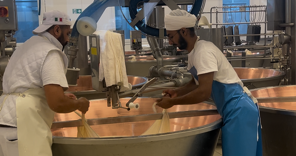
We watched the process of the cheesemakers “fishing” out the compact ball of curd that eventually becomes Parmesan. They took large linen cloths and tossed it into the liquid in the cauldron and fished out the curd much like a fisherman would catch fish with a net.
The parmesan cheese balls wrapped in linen are led down a conveyor belt along the ceiling (photo above) and placed in molds known as “fascera” that will give the cheese its final shape (photo below).
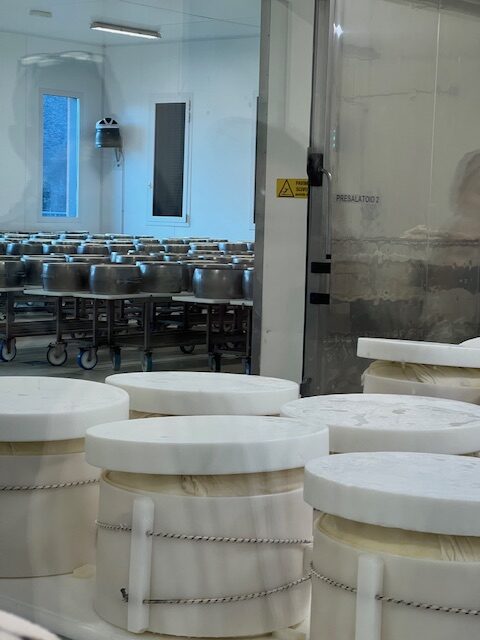
Through the application of a casein plate, each wheel is given a unique, sequential alphanumeric code. This code represents the identity card of the cheese and makes it possible to trace it back to its origin at any time and anywhere.
The minimum ageing time is 12 months. An expert from the Consortium examines each wheel one, by one. The first class “prima categoria” Parmigiano Reggiano wheels bear the marks of origin (the dotted inscription and the casein plate) and the selection mark. This cheese is highly suitable for ageing, even for a period of years.
Those wheels whose characteristics are more suited for a short aging period are identified with parallel groves around the circumference that, in addition to the marks of origin, make them immediately identifiable by consumers. In packaged portions, a label is attached to identify the cheese as Parmigiano Ressiano “Mezzano”. (photo below)
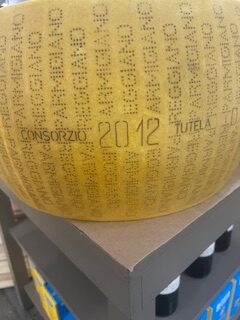
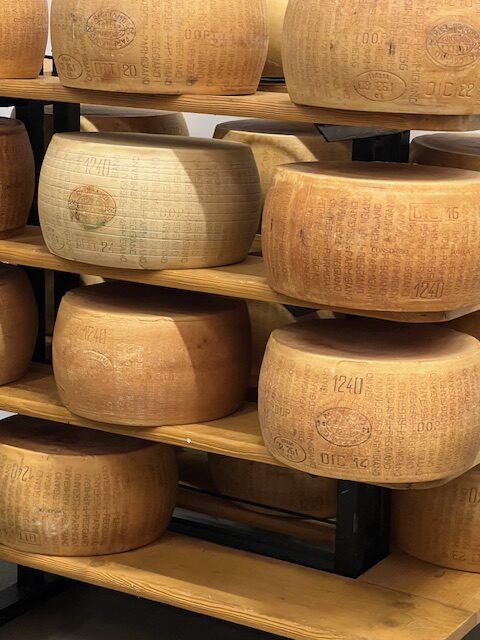
How to cut this huge wheel of hard cheese? When I worked at a cheese shop years ago, we set the wheel of Parmesan on a butcher block island. Two of us would cut the cheese by using a wire cutter with a wooden handle on each end. The wire was very sharp and we would see-saw the wire back and forth, carefully pulling the wooden handles towards us until the parmesan wheel was cut in two.




One Response
Even though I was there I had forgotten much of that detail. Nice job!